Table of Contents
Zero-click marketing is the editorial method of AI SEO that delivers the full informational value of a piece of content at the point where the reader meets it, such as the results page, a feed or an AI assistant’s answer. According to Pew Research’s analysis of 68,879 Google searches from July 2025, an AI Overview is associated with organic clicks in 8% of visits, compared with 15% of visits that show traditional results only.
The generated answer becomes the user’s first point of contact, and a brand citation inside that answer produces direct visibility. Across our work with Italian companies and clients in Southeast Asia, we see the same pattern in different markets and languages. Organic traffic shrinks and sales inquiries grow, so the return on a piece of content shows up in indicators beyond traffic.
What Zero-Click Marketing Is and Why It Is Redefining AI SEO
Zero-click marketing is a content strategy that delivers complete value at the point where the reader is. The term was coined in July 2022 in an article by Amanda Natividad published by SparkToro, then the company’s VP of Marketing.
Two related concepts play distinct roles.
- Zero-click marketing is the brand’s editorial choice to publish content that is complete in itself on any platform.
- Zero-click search is the user’s behavior of reading the answer on the results page and ending the session there.
The Traffic-First model measures content in sessions and clicks. The Visibility & Impression-First model measures how often the brand appears, how it is described and how many users search for its name shortly afterwards.
The Pew Research analysis of 900 US adults from March 2025 describes that the session ends right after the results page in 26% of cases with an AI summary and in 16% of cases with traditional results only. Links inside the summary receive a click in 1% of visits, so a citation builds brand recognition and produces few sessions.
Citation value grows because supplier research increasingly starts with an AI assistant. In the Wynter survey of 101 CMOs at B2B SaaS companies from January 2026, 84% use language models to discover suppliers, up from 24% in the previous survey, and 68% start their research with an AI tool before a traditional search engine.
The sample is American and covers companies above $50 million in revenue, so it indicates a direction. A brand cited in that first answer joins the supplier shortlist before anyone visits its website.
Artificial Intelligence in SEO is about shifting the work from page position to brand presence in the answer.
The Key Differences in the GEO vs SEO Comparison for an SME
SEO optimizes a page to rank in a list of results. GEO, Generative Engine Optimization, structures information so that a language model selects it and cites it in the answer. The GEO vs SEO comparison therefore comes down to how success is measured.
| Aspect | Traditional SEO | GEO and AEO |
|---|---|---|
| Goal | URL position in the SERP | Brand presence in the generated answer |
| Unit of work | The whole page | The individual extractable block of text |
| Main signals | Links, relevance, technical aspects | Authority, third-party sources, semantic clarity |
| Success metric | Clicks, CTR, sessions | Citations, branded searches, share of presence in answers |
| User behavior | Navigates to the results | Reads the answer and decides afterwards |
This scope includes AEO SEO, or Answer Engine Optimization, which works on the direct answers of search engines. GEO extends the same work to conversational models such as ChatGPT, Claude, Gemini and Perplexity.
Searches phrased as questions often trigger an AI summary. In the above mentioned Pew Research analysis of March 2025, an AI Overview appears in 60% of queries that start with a question word such as who, what, when or why, and in 18% of all searches. To increase the visibility of its content, an SME should therefore write its key sections as answers to specific questions and give the answer straight away, in the first lines that follow.
According to the same Pew Research analysis, in Google’s AI Overviews (AIO), Wikipedia, YouTube and Reddit together account for 15% of the links cited.
The Semrush AI Visibility Index 2026 adds that AI platforms rely on customer reviews, community discussions, independent publishers and industry sources to understand and recommend brands.
The Google Gemini SEO topic confirms that each platform follows its own logic. The Semrush study, executed on 126 million US prompts, collected between January and April 2026 across ChatGPT, Gemini, AI Mode and AI Overviews, indicates that 36 global brands out of over 1,200 held a top-100 position on all four platforms in every month.
How to Implement Zero-Click Marketing in 4 Steps
Implementation takes four interventions. You need content that answers immediately, structured data that matches the visible text, citations on authoritative third-party sources and micro-copy that prompts users to search for the brand by name.
| Step | What it strengthens |
|---|---|
| Immediate-answer content | How easily the text can be extracted |
| Consistent structured data | The company’s identity as an entity |
| Digital PR and brand mentions | Confirmation from external sources |
| On-SERP conversion | Searches for the brand by name |
AI for SEO covers the entire content chain, from the single page to the brand’s external reputation.
Content That Answers Immediately
Each section opens with an answer of one or two sentences, and the rest of the paragraph supports it with data and examples.
An SEO content strategy built for AI extraction reorganizes existing texts before producing new ones. It helps to start from the pages that already bring in leads and to give every section a short opening answer, followed by a table or a list.
AI speeds up the first draft of these answers. A human editor’s review turns the draft into a text with a point of view, which removes the filler that readers spot at once.
Semrush proposes a simple check with removing the CTA text and link from the content and checking whether the rest stands on its own. Content that passes the check delivers its value inside the AI answer that cites it.
Structured Data Consistent with the Text
Schema.org structured data declares in machine-readable format who the company is, what it offers and where it operates.
The Google Search Central documentation on AI features states that the same SEO fundamentals apply to AI Overviews and AI Mode, with structured data that mirrors the visible text on the page. Organization, Article and Person markup therefore keeps markup, page and external sources consistent.
Source attribution needs oversight. The Tow Center test by the Columbia Journalism Review from March 2025 asked eight generative search tools to identify the source of excerpts from news articles. The answers were wrong in over 60% of queries, with invented links and copies of articles cited in place of the original.
A wrong attribution of a service or a location damages the company’s reputation. Consistent structured data and a human review of every declared fact reduce the risk.
Digital PR and Brand Mentions
Mentions on authoritative third-party sources confirm to the models what the site declares.
An SME starts from publication venues close to its sector, such as trade magazines, associations, chambers of commerce and professional communities. An interview, a signed contribution or an updated listing on a review platform such as G2 produces mentions that a model can cross-check against the site.
A consistent profile across several sources builds E-E-A-T, Google’s quality criteria based on experience, expertise, authoritativeness and trustworthiness. For clients operating in Italy and internationally, it helps to cover sources in the language of each market and to check which ones appear when the same question is asked in different languages.
On-SERP Conversion
Micro-copy decides whether the user, after reading the answer, searches for the brand name.
Micro-copy is the short text that accompanies the company name in answers, titles, meta descriptions and external profiles. A clear one-line positioning, repeated consistently, settles in the reader’s memory. The branded search becomes the measurable signal of a step that happened elsewhere.
Does your brand show up in the answers of ChatGPT, Gemini and Perplexity?
Request a personalized GEO audit
How to Measure the Results of Zero-Click Marketing
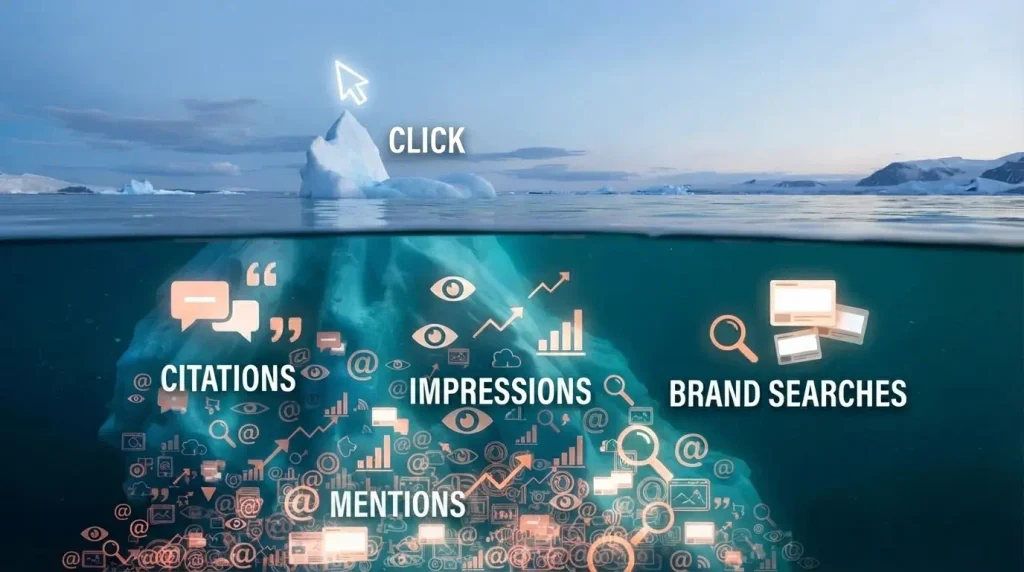
Results are measured with presence indicators. Share of Model, searches for the brand name, impressions in Google’s AI features and the source declared by customers together describe the effect of content read inside the AI answer.
| Indicator | What it measures | Where to find it |
|---|---|---|
| Share of Model | Share of AI answers in which the brand appears for a set of industry questions | Manual tests and AI visibility tools |
| Mentions and citations | Brand presence in the text and use of the domain as a source | AI visibility tools |
| Impressions in AI features | Pages that appear in AI Overviews and AI Mode | Search Console |
| Branded searches | Searches that contain the company name | Search Console |
| Source declared by the customer | Channel named by leads and customers | Contact form and sales calls |
AI SEO requires a dashboard with presence indicators next to traffic indicators. The Google announcement of 3 June 2026 describes metrics on impressions in generative features, with the pages that appear in AI answers and the countries of origin, plus a control that lets each site choose whether to take part. Since 31 August 2026 these features have been available to all websites worldwide.
Share of Model is the share of answers generated by a model in which the brand appears, calculated on a fixed set of industry questions. It should be read alongside two indicators that the Semrush AI Visibility Index keeps distinct. A mention shows that the brand appears in the text of the answer. A citation shows that the domain is used as a source.
The same Semrush study finds that 45% of marketing leaders face limits in accurately measuring their visibility in AI answers.
The cheapest check is still the direct question. On the contact form and in sales calls, it helps to ask how the customer discovered the company and to include AI assistants among the answer options.
To demonstrate return in B2B, three data points belong in the same report. They are branded search growth, the share of leads who name an AI assistant or a citation as their first contact, and sales cycle length. A counterpart who is already informed skips the discovery phase and can shorten the sales cycle, an effect the report should be able to show.
Frequently Asked Questions About Zero-Click Marketing
What is zero-click marketing?
Zero-click marketing is a content strategy that delivers a complete answer at the point where the reader meets it. It builds brand recognition and trust directly on the results page, in the feed or in an AI assistant’s answer.
What is the difference between zero-click marketing and zero-click search?
Zero-click marketing is the brand’s editorial choice. Zero-click search is the user’s behavior of reading the answer on the results page, often an AI Overview, and ending the session there.
How many users click a result when Google shows an AI Overview?
8% of visits with an AI Overview and 15% of visits with traditional results only, according to the Pew Research analysis of 900 US adults from March 2025.
How do you measure zero-click marketing when direct traffic to the site declines?
With Share of Model, branded searches, impressions in the AI features of Search Console and the source declared by the customer on the contact form.
Does zero-click content hurt conversions?
Zero-click content moves conversions to a later stage of the journey. The reader gets to know the brand from the answer, searches for it by name at the moment of purchase, and the branded search records the step.
What makes content citable by artificial intelligence systems?
A structure with clear headings, a short answer at the start of every section, original data, structured data consistent with the text and mentions on authoritative third-party sources.
How do you implement zero-click marketing?
In four steps. Rewrite content with immediate answers, declare consistent structured data, build mentions on third-party sources and refine the micro-copy that leads to a brand search.
Bringing Your Brand into AI Answers
Zero-click marketing works alongside traditional SEO and adds a further goal, getting a model to choose the brand as its source in every answer where a user looks for a supplier in the sector.
At Vettore Consulting we work on this transition with Italian and international companies. We start with a GEO audit that shows where the brand appears today in the answers of ChatGPT, Gemini and Perplexity. Every fact the site declares goes through human review, because a wrong description in AI answers creates a reputational cost that only surfaces when the answers themselves are monitored.
Contact us for a personalized GEO audit. We analyze your company’s presence in AI-generated answers, compare your visibility with direct competitors and define the actions suited to your market.