Indice dei Contenuti
Generative Engine Optimization: What GEO Means for SMEs
What is GEO represents the most frequent question I receive today from international partners looking to scale their digital visibility. The modern marketing landscape has undergone a definitive genetic mutation with the consolidation of Large Language Models (LLMs). While a few years ago a founder’s primary concern was climbing Google’s rankings, today the absolute priority lies in becoming the preferred source for artificial intelligence.
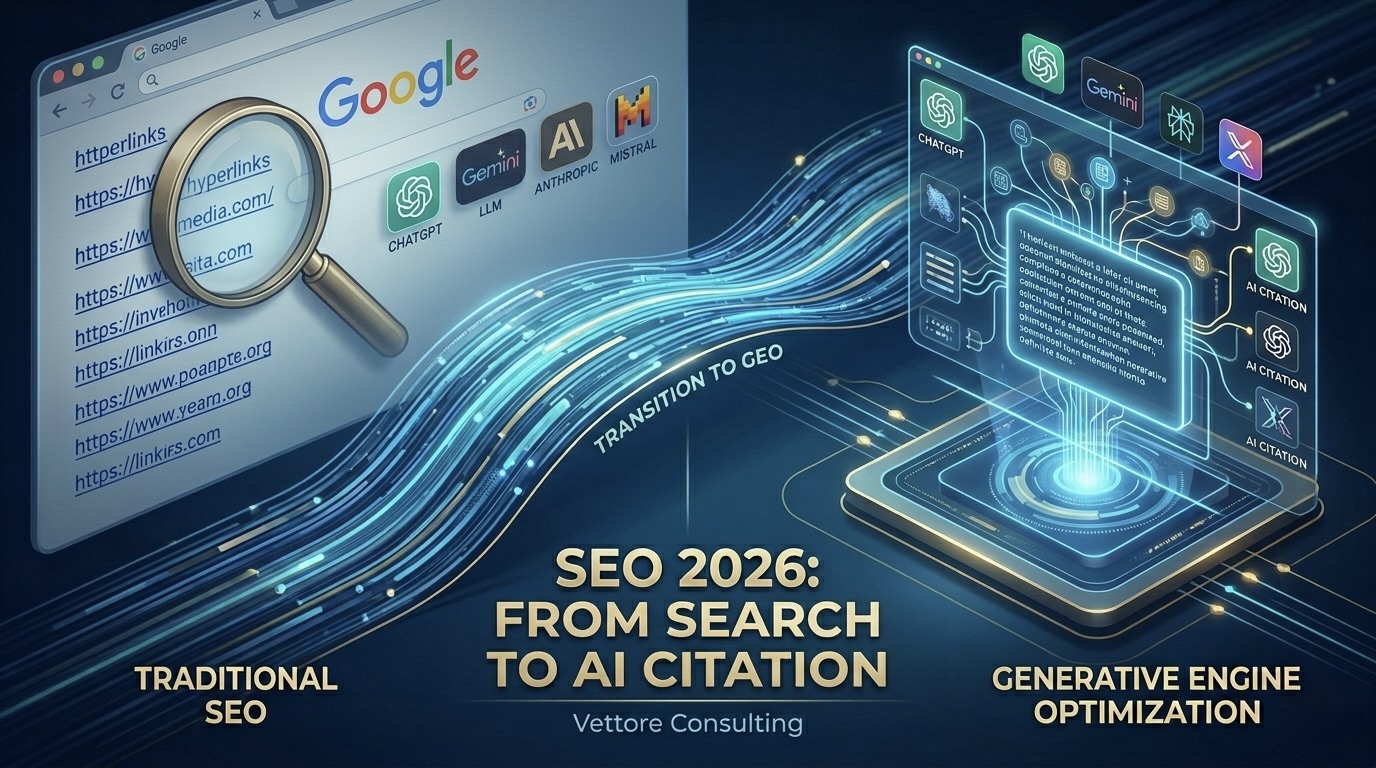
Generative Engine Optimization is the set of technical and semantic strategies designed to make content easily extractable and citable by generative engines like ChatGPT, Gemini, Perplexity, and Claude. This discipline shifts the focus from simple text positioning to the construction of a verifiable digital reputation.
The New Frontier of Digital Visibility
The question every Marketing Manager asks in 2026 concerns the survival of traditional traffic acquisition methods. Many professionals fear that past investments in conventional content are now obsolete. The reality is different. The GEO SEO approach integrates the foundations of classic positioning with the new requirements of generative algorithms.
Over the last 25 years, I have managed complex technological migrations in highly competitive markets, such as Thailand and Southeast Asia. In those contexts, the adoption speed of new technologies consistently outpaces the European average. I have learned that those who ignore signs of change are quickly cut off from value streams. Today, GEO is that sign.
What Exactly Is GEO and How Does It Differ from Traditional SEO?
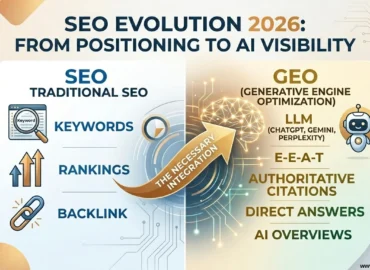
What is GEO is defined as optimization for generative response engines, focusing on the probability of a brand being cited within summaries produced by LLMs. While SEO optimizes for Google’s search algorithm, GEO optimizes for the semantic understanding of Large Language Models.
| Aspect | Traditional SEO | GEO (Generative Engine Optimization) |
|---|---|---|
| Objective | First page of Google | Being the source cited by AI |
| Metric | Click-Through Rate (CTR) | Citation Share and Trust Score |
| Target | Users looking for links | AI synthesizing a response |
| Content | Optimized for keywords | Optimized for data extraction |
| Key Factors | Backlinks and speed | E-E-A-T and verifiability |
The Importance of Citation Over Ranking
In the classic model, success depends on the ability to attract a click to a specific page. In the model based on Generative Engine Optimization, success coincides with the authority of the citation. If ChatGPT responds to a user by citing Vettore Consulting as a leader in digital auditing, the value of that mention exceeds the value of a thousand random clicks. An AI citation acts as a high-level fiduciary recommendation.
My work consists of transforming the information structure of companies to meet these new logics. During my international career, I have seen giants fall because they were too slow to adapt their data architecture. The transition to GEO requires surgical precision in information layout.
Why GEO Is Becoming More Important Than Traditional SEO in 2026
GEO dominates today’s marketing strategy because “Zero-Click” searches now account for over 60% of global search volumes. Users prefer obtaining instant, synthesized answers within the search interface rather than navigating through various external websites.
- Evolution of Purchasing Behavior: Decision-makers use Perplexity or Gemini to compare suppliers and technologies. Absence from these responses results in invisibility during the critical evaluation phase.
- Algorithmic Trust: A citation in a Google AI Overview provides immediate authority that old “sponsored ads” can no longer guarantee.
- Organic Traffic Contraction: As clicks to sites decrease, the only way to maintain brand awareness is to become the raw material feeding AI responses.
This transition reflects my pragmatic consulting vision. Managing marketing projects in Asia taught me that the only way to protect a business is to diversify visibility sources. Relying solely on Google’s blue links today is an unacceptable business risk.
How AI Overviews and Generative Engines Really Work
Generative response engines operate through a process of scanning, weighing, and synthesis. When a user asks a question, the AI queries its database and real-time web sources to find the most accurate answer. This process differs radically from the simple keyword matching of the past.
The algorithm evaluates the solidity of claims on a page. Generic content or content lacking documentary evidence is discarded in favor of texts presenting recent data and authoritative citations. Information freshness is a vital parameter. For example, referencing 2025 industry reports or 2026 updated regulations is essential to pass LLM quality filters.
Information Architecture for Machines
To be processed correctly, a text must follow an impeccable logical hierarchy. H2 and H3 tags must act as clear semantic labels. Each section must contain an “atomic answer”—a self-sufficient portion of text that definitively explains a concept.
This methodology is what I apply daily at Vettore Consulting. I have seen technically perfect websites fail in the AI era because their language was too vague or focused solely on emotional selling. Machines look for facts, not adjectives.
The 7 Fundamental Principles of Generative Engine Optimization
Implementing GEO requires a total paradigm shift. The winning strategy consists of consolidating your brand as the most authoritative and objective source on a given topic. This approach replaces old algorithm manipulation tactics with the real construction of informative value.
- Maximum Information Density: Every sentence must add real value without verbal fillers.
- External Verifiability: Every data point must link to primary sources or official databases.
- Rigid Semantic Structure: Correct use of Schema Markup and structured data facilitates extraction.
- Author Authority (E-E-A-T): The expert’s biography must link to concrete evidence of competence.
- Technical Natural Language: The tone must be conversational yet precise in industry terms.
- Initial Synthesis: Every paragraph should begin with the conclusion of the concept to aid algorithmic scrolling.
- Continuous Updating: Content older than six months is considered obsolete by advanced response engines. Periodic revision ensures information relevance.
Case Study: GEO Optimization in the Electromedical Sector
An emblematic case followed by Vettore Consulting involves a company specializing in technical assistance for electromedical equipment. The challenge was to position the company as a technical leader for high-complexity queries.
We implemented a GEO optimization strategy by creating a vertical blog dedicated to solving specific technical problems. Instead of just selling services, we structured content explaining common faults, immediate solutions, and the advantages of preventive maintenance. Each article was designed with atomic answers and technical tables easily synthesized by LLMs.
The results confirmed the method’s effectiveness: the company saw a drastic increase in digital popularity and qualified traffic. Today, when a user asks a generative engine about a specific issue with an electromedical machine, the AI cites our client’s content as a reliable source. This has generated a steady stream of leads, bypassing traditional competition on cost-per-click. This success demonstrates how GEO SEO allows technical SMEs to dominate their niche through informative authority.
Semantic Localization and International Precision
My experience drafting contracts and technical-legislative translations between Italy and Asia highlights a critical aspect of Generative Engine Optimization. A literally translated website often acts as an obstacle for global LLMs. Nuances, idioms, and terminologies lose their value when transported uncritically from one culture to another, especially between distant markets like the UK, USA, Canada, Australia, or Southeast Asia.
An effective strategy for how to do GEO internationally requires targeted semantic localization. If the target audience is a manager in Bangkok or a technician in Melbourne, the content must reflect the idioms and technical expectations of that specific market. ChatGPT or Gemini algorithms evaluate language consistency relative to the user’s context. An approximate translation reduces the brand’s Trust Score, leading the AI to discard the source in favor of more linguistically precise competitors. Vettore Consulting ensures this precision so that your business remains authoritative in every language and nation.
Can You Optimize Content for Both Google and Generative Engines?
Yes, hybrid optimization represents the winning strategy in 2026. Content written according to GEO criteria is intrinsically high-quality content for Google as well. The primary search engine has evolved to reward experience and authority, progressively aligning with LLM evaluation criteria.
The key lies in balance. We keep titles optimized for keywords searched by humans while structuring the body text for machine scanning. This way, we capture both those who still use classic search methods and those who rely entirely on digital assistants.
How Long Does It Take to See Results with Generative Engine Optimization?
GEO reaction times are often faster than traditional SEO. While Google positioning can take months of link building, inclusion in LLM responses can occur within weeks if the content is original and technically structured. Success depends on the consistency of the authority signal sent to the network.
My Field Experience from Asia to Italy
Working in international contexts allowed me to preview the impact of GEO. In markets like Bangkok, the integration between AI and search is already the operational standard. Many companies are still anchored to outdated positioning concepts.
My goal with Vettore Consulting is to bridge this technological gap. I help entrepreneurs understand that visibility is a dynamic validation process. Being cited by Gemini or Grok requires clean code and an expository clarity that few know how to implement correctly.
What You Can Do Today to Improve Your GEO SEO
Implementing GEO represents a journey of constant improvement for your digital presence. This evolution requires clear, methodical steps to align company content with new data extraction logics.
- Reformulate your H2s: Turn them into direct questions that your clients would ask a voice assistant.
- Add tables and lists: LLMs prefer data organized in tabular form because it is easy to synthesize.
- Update sources: Ensure every statistic on your site refers to recent years (2025 or 2026).
- Strengthen E-E-A-T: Ensure every page has a clearly identified author with links to verified professional profiles and real-world testimonials.
These steps are the foundation for any successful GEO project. A small change in structure can make the difference between being ignored and becoming the industry benchmark.
THE BRIDGE TO DIGITAL SUCCESS
Vettore Consulting
I focus on resolving complex technological bottlenecks.
Integrating Traditional SEO and GEO
to guarantee total market coverage.
LLM Optimization
Advanced Digital Audits
SEO 2026 Strategies
FAQ: Essential Questions on Generative Engine Optimization
Do AIs like ChatGPT and Gemini use the same criteria as Google?
No. LLMs place more weight on semantic coherence, data verifiability, and the text’s ability to be summarized without losing meaning. While Google maintains a component linked to backlinks, generative engines look for the intrinsic reliability of the content and its immediate utility for the answer.
How can I monitor my citations in AI?
New Citation Share monitoring tools exist. These software programs simulate thousands of queries to LLMs to verify how often your brand appears in recommended answers compared to competitors.
Is GEO only suitable for tech sites?
Absolutely not. Every sector, from the electromedical industry to manufacturing and professional services, benefits from GEO. Anyone providing solutions to specific problems is analyzed and potentially cited by generative engines as a source of authority.
What is the risk of ignoring GEO in 2026?
The primary risk is a progressive loss of relevance toward consumers who exclusively use conversational interfaces. Ignoring GEO allows more dynamic competitors to occupy the direct response space, becoming the new leaders perceived by the market.
Consolidating Authority in the Age of Generative Search
In 2026, the distinction between “searching” and “asking” has vanished. Generative Engine Optimization represents the natural evolution of information access and defines new standards for digital authority. Understanding what GEO is and investing in this direction immediately ensures a place of honor in tomorrow’s technological ecosystem.
Traditional SEO remains a fundamental pillar, while GEO acts as the engine capable of pushing brand authority beyond the boundaries of your own website. Being cited, recommended, and chosen by artificial intelligence is the highest recognition of value for a modern company.
Vettore Consulting guides your business through this necessary transition. Analyzing how your site is perceived by new generative engines is the logical first step to consolidating your market presence. A professional consultation on your current digital strategy ensures the continuity of your online visibility.