Table of Contents
SEO 2026: The shift I have witnessed over 25 years
Over the last 25 years, the SEO world has undergone radical and constant transformations. I began my career when ranking a website on the first page of Google was a linear and predictable technical process. During that period, execution speed and code precision guaranteed results to anyone with the right technical skills. I have managed complex international projects in Thailand and throughout Southeast Asia. In that market, global competition dictated extremely aggressive strategies, vastly different from those commonly used in Italy. These field experiences have forged my current vision of digital marketing.
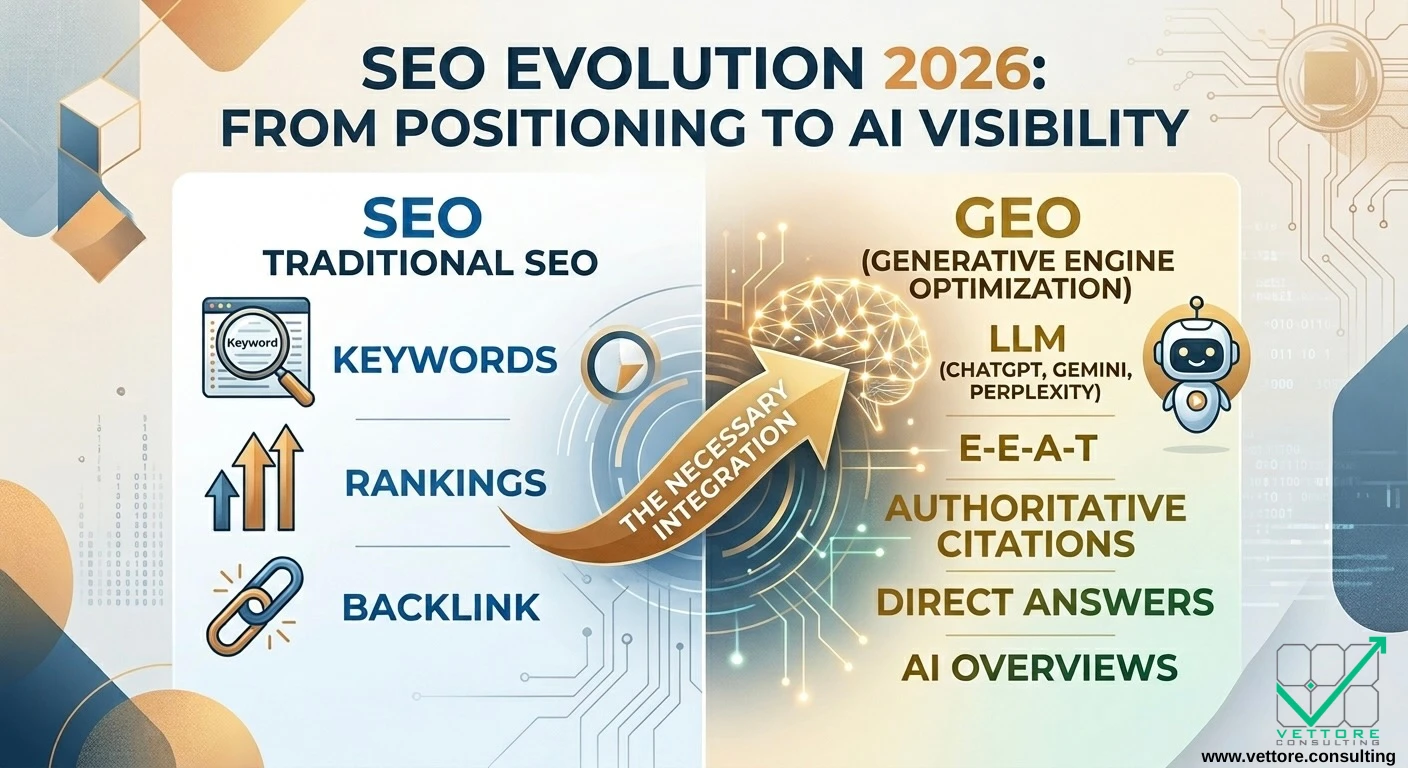
Today, in 2026, I state with absolute certainty a truth that is uncomfortable for many industry insiders. Traditional SEO still exists, but it is no longer sufficient to sustain a truly competitive digital business. The current landscape demands a leap toward GEO (Generative Engine Optimization) which focuses on making content understandable and referable by generative models. This evolution represents the primary challenge for every SME owner or Marketing Manager wishing to maintain relevant visibility in the coming years.
What traditional SEO was and why it is now incomplete
Traditional SEO encompasses techniques aimed at climbing the rankings of classic search engines. It focuses on keyword optimization, link building, and technical speed. In 2026, this approach only guarantees partial visibility because it ignores the direct answers provided by artificial intelligence.
Until a few years ago, the path to online success was clearly mapped out for every professional. Key objectives included:
- Meticulous selection of high-volume keywords.
- Detailed optimization of titles, meta descriptions, and internal content.
- Building a network of backlinks from high-authority domains.
- Constant improvement of Core Web Vitals and user experience.
This approach provided steady streams of organic traffic for over two decades. It continues to generate value for niche sectors and portals with long-standing authority. However, this system now covers only a small fraction of the modern user’s decision-making journey. The consumer of 2026 interacts with technology in a conversational and immediate way. Simply appearing in a list of “blue links” no longer meets the needs of those seeking rapid, verified solutions.
The 6 major changes in SEO 2026
SEO 2026 is dominated by AI Overviews and the progressive disappearance of the traditional click. Algorithms from Google and new generative engines synthesize information for the user. Strategic victory lies in being the cited source within these automated summaries.
1. The era of Zero-Click Searches and AI Overviews
More users are finding the ultimate solution to their problems directly on the main search page. AI Overviews provide complete and accurate summaries. This phenomenon eliminates the need to visit individual websites for informational queries. Visibility in 2026 means appearing as the primary source feeding the AI-generated response. SMEs must recalibrate their KPIs, shifting focus from raw traffic to the share of citations obtained in direct answers.
2. The supremacy of Generative Engines
ChatGPT, Gemini, Perplexity, and Claude are the new protagonists of the global information market. These engines read, understand, and synthesize the entire body of knowledge available online. Their primary function is the deep processing of data present on global servers to provide contextualized answers. Ranking first on Google remains a valid goal. Being recommended by these conversational systems has become the only way to intercept high-intent leads. These tools act as true digital consultants for the end user.
3. The decisive importance of the E-E-A-T protocol
Experience, Expertise, Authoritativeness, and Trustworthiness have become tangible and measurable ranking factors. Artificial intelligences select sources based exclusively on their proven reliability. This serves to prevent the spread of hallucinations or serious technical errors. Your professional authority is the numerical parameter that determines your inclusion in generative responses. Vettore Consulting works specifically on building this digital trust through verifiable and structured content.
4. The contraction of classic organic traffic
Many of my international clients have seen significant drops in organic traffic, often between 30% and 50%. Their positions for key keywords have remained unchanged in classic rankings. The reason lies in the radical shift in information consumption habits. People read the AI-produced synthesis and consider their search complete without ever landing on the source website. This reality demands a content strategy that is much deeper and oriented toward immediate conversion.
5. Multi-engine and semantic optimization
Current marketing strategy must speak simultaneously to classic search engines and response engines based on Large Language Models (LLMs). Modern consultancy requires a holistic vision of the digital landscape to intercept the user on every platform. This requires the adoption of natural, technically precise, and unambiguous language. Data structure must be flawless to allow machines an instantaneous understanding of the value offered by the company.
6. The metamorphosis from positioning to citational visibility
The historical goal of SEO was to appear among the top ten SERP results. The goal for 2026 is winning “Citation Share.” Visibility today coincides with the digital reputation that generative algorithms attribute to your brand. Being cited means being recognized as an industry expert. This form of recognition has a commercial value immensely superior to a simple random click from a generic search.
Comparative Analysis: The transition from SEO to GEO
| Strategic Parameter | Traditional SEO (Past) | GEO – Generative Engine Optimization (Future) |
|---|---|---|
| Operational Goal | Scaling rankings | Becoming the AI-cited and recommended source |
| Control Metric | Number of clicks and organic sessions | Citation Share and Trust Score |
| Content Nature | Based on keywords and text density | Based on authority, hard data, and natural language |
| Information Architecture | HTML tags, Meta tags, and page speed | Semantic structure, entities, and verified citations |
| User Experience | Navigating through site pages | Consuming the response within the AI interface |
| Conversion | Landing on a landing page | Perception of the brand as an authoritative leader |
Quick GEO Checklist: Is your site AI-ready?
Don’t just read about the evolution: verify the state of your digital presence now. Answer these 5 questions to understand if your current strategy is obsolete or ready for 2026.
- Clear Semantic Structure: Do your main pages use H2 and H3 tags to directly answer specific questions (e.g., “What is…”, “How to…”) with brief definitions (40-50 words)?
- Verifiable Data and Citations: Does your content cite authoritative sources, recent industry reports (2024-2025), or current regulations, making information easily validable by LLMs?
- Natural and Assertive Language: Do your texts avoid excessive jargon and unnecessary negations, focusing on direct and assertive sentences that clearly explain what your solution is?
- Use of Lists and Tables: Do you use bullet points and comparative tables to synthesize complex information, facilitating data extraction by generative algorithms?
- Visible E-E-A-T Optimization: Are author bios, case studies, and client testimonials easily accessible and structured to demonstrate your real-world expertise?
Results:
- 4-5 “Yes”: Great job! Your site has a solid GEO foundation. Now focus on “Citation Share.”
- 2-3 “Yes”: You are halfway there. You risk losing traffic to more prepared competitors.
- 0-1 “Yes”: Your strategy is obsolete. You need an immediate Digital Audit.
The evolution of the Italian and international markets
My years of experience between Italy and Asia allow me to observe these changes from a privileged perspective. The Italian market often exhibits cultural resistance to technological innovation. Many SMEs continue to invest in SEO techniques born a decade ago. Conversely, more dynamic international markets have already embraced GEO as a fundamental pillar of their marketing.
Those operating globally know that competition has shifted to data quality. A poorly translated website or one with generic information is ignored by modern LLMs. Vettore Consulting supports companies through this delicate transition. We help professionals transform their wealth of expertise into a format that is readable and appreciated by the latest generation of artificial intelligences in multiple languages. This approach guarantees commercial solidity that protects the company from the fluctuations of Google’s algorithms.
GEO Strategy: How to scale authority in 2026
The GEO strategy is based on validating corporate information to make it attractive to LLMs. This process requires the use of updated data, primary source citations, and total expository clarity. GEO transforms your site into an authoritative knowledge archive that machines are happy to recommend.
The centrality of certified information
Large Language Models prefer content that includes regulatory references and recent statistical data. For example, including references to the latest European digital security directives of 2025 or citing industry reports updated to 2026 drastically increases the chances of appearing in AI Overviews. Information freshness acts as a quality signal that search engines use to filter out mediocre content. A company demonstrating knowledge of its sector’s legislative evolution is perceived as a natural leader.
Response precision as a growth driver
Artificial intelligences need direct answers to satisfy user requests. Every paragraph of your corporate site must aim for maximum informational transparency. Eliminating verbal ambiguities and adopting an assertive tone facilitates the semantic indexing process. This precision simultaneously improves the experience for potential human clients. A user who receives a clear and immediate answer develops instantaneous trust in the professional or company.
Case studies and application scenarios for SMEs
Many entrepreneurs ask how to concretely apply these abstract concepts to their daily reality. Imagine an IT consultancy firm or an international event management office. In the old SEO model, these companies would have tried to rank for “IT support” or “international event organization.” In the SEO 2026 model, the strategy changes radically.
The company must produce detailed analyses of specific problems. It must explain how to resolve a security flaw in a cloud system or how to manage the digital logistics of an event with ten thousand participants. This content, rich in technical details and practical solutions, becomes the ideal resource for engines like Perplexity or ChatGPT. When a potential client queries the AI about a complex technical problem, the algorithm cites the companies that have provided documented and authoritative proof of their competence.
THE BRIDGE TO DIGITAL SUCCESS
Vettore Consulting
I focus on resolving complex technological bottlenecks.
Integrating Traditional SEO and GEO
to guarantee total market coverage.
LLM Optimization
Advanced Digital Audits
SEO 2026 Strategies
FAQ: Essential questions about SEO 2026
What is the main difference between SEO and GEO?
SEO deals with how search algorithms list websites based on relevance and technical authority. GEO focuses on how language models extract and recommend specific information. SEO aims for the click; GEO aims for the direct citation in the AI’s response.
How can I measure the success of a GEO strategy?
Traditional metrics like Bounce Rate are becoming less relevant. You must monitor “Brand Mention Share” within AI-generated responses. Specific tools exist to simulate queries to major LLMs to verify if your brand appears among the recommended solutions.
Is my current site already compatible with SEO 2026?
Most websites designed before 2024 require significant updates. They often lack necessary data structures or the language is too oriented toward old keywords rather than semantic concepts. A technical check-up is fundamental to avoid losing competitiveness.
How long does it take to see the first results with GEO?
Semantic indexing can be faster than classic positioning. If the content is of the highest quality and meets an urgent informational need, LLMs can start citing it within a few weeks. Building solid authority still requires a consistent commitment of at least 6 months.
Why should I worry about Zero-Click Searches?
Ignoring this phenomenon means accepting a constant loss of potential leads. If your site does not provide answers that AI can synthesize, your competitors will do it for you. Being present where the user receives the answer is the only way to stay in the consumer’s mind.
The future belongs to those who evolve
The rules of the digital game are changing with unprecedented speed. Two factors, however, remain constant and decisive for the success of any business. The first is a deep understanding of the digital space where your ideal client moves. The second is the ability to be perceived as the most authoritative and reliable source for solving a specific problem.
GEO represents the most mature and intelligent evolution of online search. This discipline raises the web’s quality standards, rewarding content substance over simple technical optimization. Integrating these techniques with traditional SEO allows for extraordinary business results. Those who choose to ignore this transformation risk digital invisibility within the next two years. Those who decide to embrace the change will achieve an unassailable leadership position.
Is your site optimized only for Google or also to be cited by artificial intelligence?
This is the fundamental question for every modern entrepreneur. In the next article, we will explore the practical steps to begin this transformation from scratch. If you desire an immediate and professional analysis of your current digital strategy, contact me today for a personalized consultation. Together, we will build the future of your online visibility.